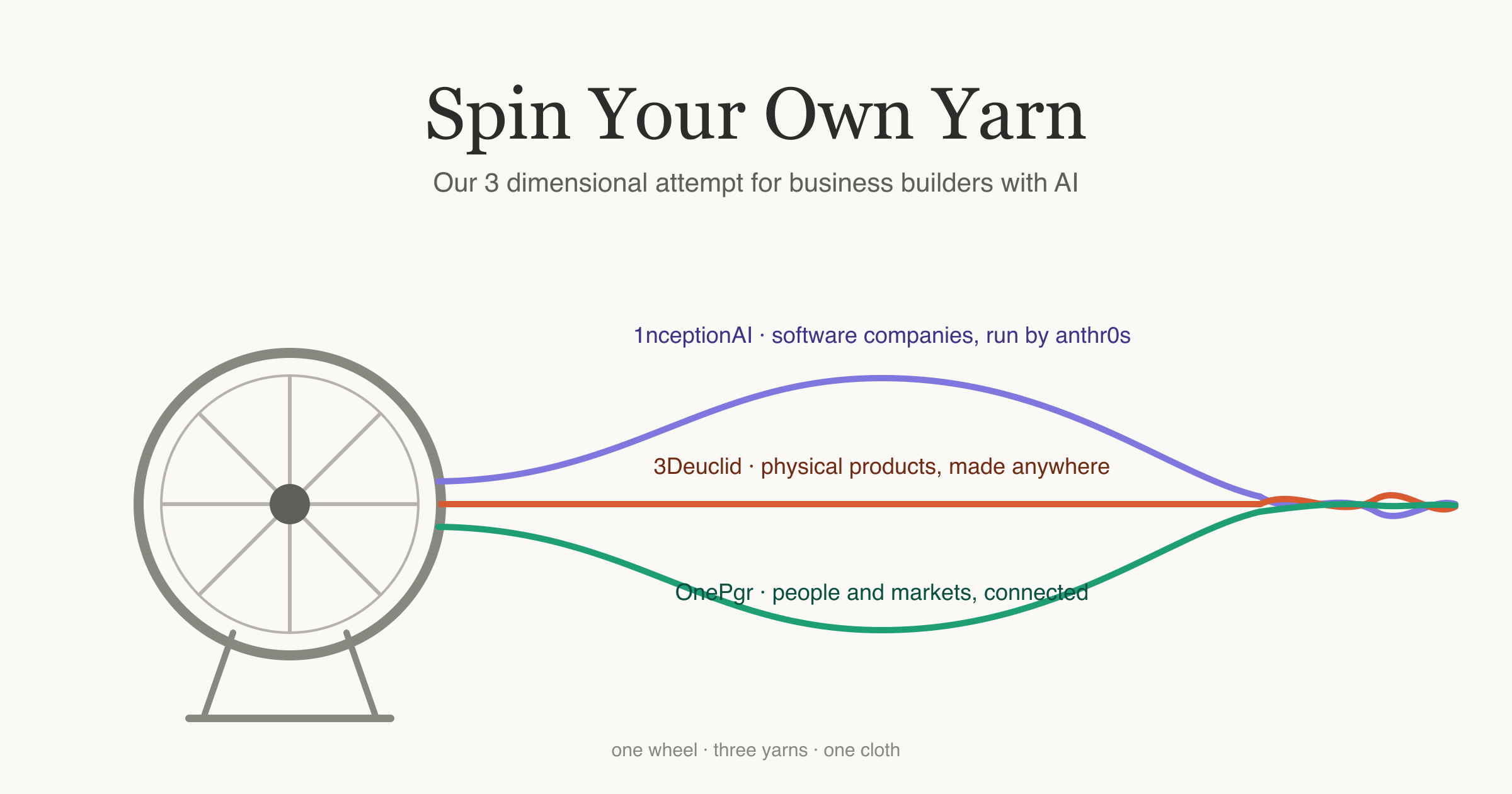
Spin Your Own Yarn
Our 3 dimensional attempt for business builders with AI
In 1908, Mohandas Gandhi wrote about a machine he had never learned to operate. By the 1920s, the charkha — the humble spinning wheel — had become the center of a movement. Not because handspun cloth could outcompete the mills of Manchester on price. It couldn’t. But because the charkha returned something the mills had quietly taken away: the ability of an ordinary person, in an ordinary village, to produce something of value with their own hands.
Gandhi understood something that gets lost in every technology cycle since: concentration of production is concentration of power. When the means of making things belong to a distant few, everyone else becomes a consumer of what those few decide to make, at prices those few decide to charge, under terms those few decide to set. The charkha was not a nostalgic gadget. It was a technology of self-reliance — swadeshi — and it worked because it put production back where the people were.
A century later, we’ve rebuilt Manchester. We just call it Big Tech.
The three gates
Ask why the ability to build companies — real, revenue-generating, problem-solving companies — is concentrated in a handful of metros and a handful of trillion-dollar firms, and you will find three gates standing between an ordinary person and entrepreneurship:
The software gate. Building software has required either learning to code for years or raising capital to hire people who did. The tools got friendlier, but the gate held: an idea in the head of a teacher, a nurse, or a shop owner stayed an idea, because the distance from idea to running product was measured in engineers.
The hardware gate. Physical products were worse. CAD software built for trained mechanical engineers, tooling costs that started in the tens of thousands, factories that wouldn’t return your call under 10,000 units. The gate wasn’t just skill — it was capital, minimums, and access.
The distribution gate. And even those who fought through the first two gates hit the third: nobody knew they existed. Reaching the people whose problems you could solve required sales teams, ad budgets, and platforms that charge rent for access to their audiences — audiences those platforms aggregated from all of us in the first place.
Each gate has a gatekeeper, and the gatekeepers have never been richer. This is not a moral failing of any particular company. It is what happens, every time, when the means of production concentrate. The mills didn’t hate the weavers. They just made the weavers unnecessary.
The answer, then as now, is not to burn the mills. It is to build a better charkha.
What just changed
Three shifts, arriving together, have made this the first moment in a century when the gates can actually come down.
First, software can now build software. Not autocomplete — construction. AI agents equipped with skills (reusable, battle-tested units of know-how) can take a described idea and assemble it into a working product: the app, the infrastructure, the integrations. And increasingly, agents can do more than build the product — they can operate it. Answer the support tickets. Run the campaigns. Reconcile the books.
Second, atoms are catching up to bits. AI-native CAD means you can describe a part and get real, manufacturable geometry — with the constraints and tolerances a machinist would recognize — without a mechanical engineering degree. And 3D printing means the factory that once demanded 10,000-unit minimums now sits on a desk, or down the street, and profitably makes a run of one.
Third, connection can be earned instead of rented. People finding each other’s problems, teaching each other, guiding each other from awareness to solution — this no longer requires buying an audience from a platform. It requires infrastructure built for the full human arc of commerce: learn, identify, prospect, hand-hold, usher, solve, succeed.
Three gates. Three shifts. So we are building three companies — one aimed squarely at each gate.
The triad
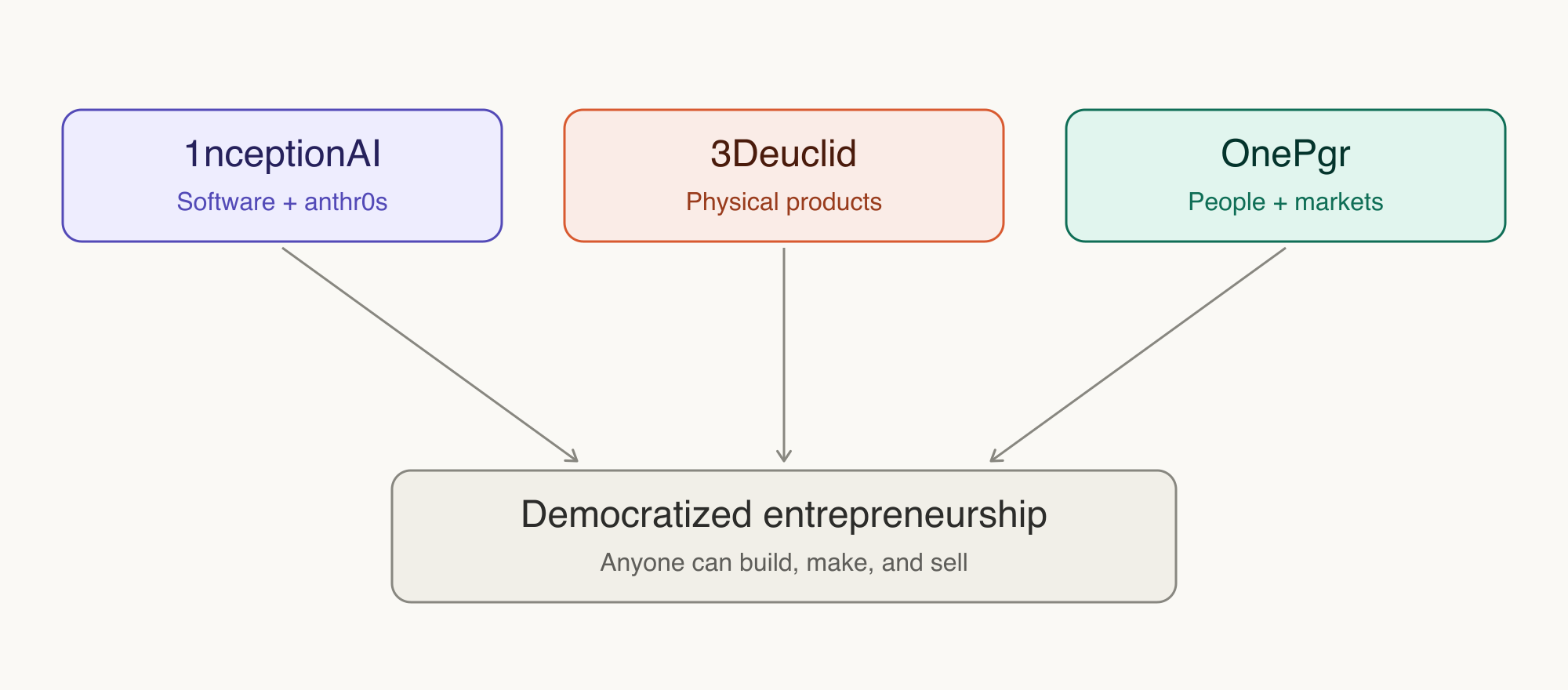
1nceptionAI opens the software gate. Describe your idea; it builds the company. Not a prototype — a company: product, infrastructure, and increasingly the autonomous entities we call anthr0s that run its operations. An anthr0 is not a chatbot bolted onto a business. It is a working member of one: an agent with skills, judgment within its lane, and a job to do. The founder’s role shifts from doing everything to directing everything — from laborer to architect. We built 1nception for ourselves first; every product in this portfolio came off its line. That is the proof: the factory is real because we live in its output.
3Deuclid opens the hardware gate. AI-native CAD that speaks human, generating geometry a machine shop or a 3D printer can actually make. Pair it with the desktop factory and something remarkable happens: the category of “hardware entrepreneur” stops being a Shenzhen-and-venture-capital story and becomes available to a machinist in Pune, a physical therapist in Ohio with an idea for a better brace, a teenager with a printer and a problem worth solving. Physical product entrepreneurship — the kind the charkha embodied — comes back to the cottage, this time with tolerances.
OnePgr opens the distribution gate. Software you can’t distribute is inventory. A product nobody discovers solves nothing. OnePgr is the connection layer: infrastructure for people to learn from each other, surface each other’s problems, and bring their faculties to bear — raising awareness, educating, prospecting, hand-holding, ushering, selling, and seeing each other through to success. Selling, here, is one verb among many. The point is not the transaction. The point is that a person with a solution and a person with a problem find each other without paying a toll to an aggregator.
The three are not a portfolio. They are one machine. 1nception builds what 3Deuclid founders and OnePgr users need. 3Deuclid proves the factory can produce hard things, not just web apps. OnePgr carries all of it to the people it’s for — including, unapologetically, these three companies themselves. We eat our own cooking in public: the outbound engine that sells our software is our software.
Why three
I’ll admit the number is not an accident. Threes have followed me around my whole life — I’ve spent the last eleven years training for triathlons, three disciplines fused into one race, with a half Ironman on the horizon. A triathlon teaches you a thing that applies directly here: you cannot sprint all three legs. You sequence. You pace. You respect that each discipline strengthens the body that performs the others — the cyclist’s legs carry the runner; the swimmer’s lungs carry them both.
The triad works the same way. At any moment, one leg leads. The others hold pace. All three finish together or not at all.
What this is not
This is not anti-technology, and it is not anti-scale. Gandhi’s charkha coexisted with mills; the point was never that everyone must weave, but that everyone could. Big Tech will keep building marvels, and we will keep using them — some of this triad runs on their infrastructure, gratefully.
Nor is this a promise that entrepreneurship becomes easy. The gates coming down does not flatten the mountain behind them. Judgment, taste, persistence, and care for real customers remain scarce — and should. What changes is who gets to attempt the climb. Today that privilege belongs mostly to people with the right zip code, degree, or funding network. Tomorrow it should belong to anyone with a real problem in view and the will to solve it.
The invitation
The measure of this master plan is not our revenue, though there will need to be revenue. It is a person we haven’t met: someone in a small town on any continent who notices a problem, describes a solution, and — without learning to code, without a factory, without an ad budget — builds a company that solves it, staffed by anthr0s, shipped from a desktop, and carried to its customers by a network of people rather than a platform of gatekeepers.
Gandhi asked people to spin for thirty minutes a day, not because the yarn mattered, but because the habit of self-reliance did. Our ask is the same shape: bring one real problem. We’ll bring the wheel.
The mills had their century. It’s time we spun our own yarn again — and this time, it compiles.
Rajiv Saxena is a founder building the full stack of modern entrepreneurship. His portfolio spans three interconnected ventures: OnePgr, a go-to-market app suite that removes the distribution gate for new businesses; 1nceptionAI, a platform for building software companies run by autonomous AI agents; and 3Deuclid, AI-native CAD that opens hardware entrepreneurship to anyone with an idea. Together they reflect a single thesis: the tools to start and scale a company — distribution, software, and physical product — should belong to individual builders, not be concentrated in the hands of a few large platforms. Earlier in his career, he wrote Mechanical Design Automation software as a developer at SDRC (now Siemens) and went on to hold product-management leadership roles at Microsoft, Siebel Systems (now Oracle), WebEx, and Cisco. Away from the desk, he is a committed triathlete with his sights set on completing a half Ironman one day.